Showing posts with label Mental Health. Show all posts

Jun 15, 2015

TED: "How childhood trauma affects health across a lifetime"

Dr. Nadine Burke Harris, pediatrician and founder of the Center for Youth Wellness in San Francisco's Bayview district, discusses the effects of childhood trauma on brain development and lifetime health outcomes. Dr. Burke Harris advocates screening for childhood trauma using the adverse childhood experiences (ACEs) scoring tool and providing prevention, early intervention, and treatment services.


According to SAMHSA, research shows a strong graded (i.e., dose-response) relationship between ACEs and a variety of substance use-related behaviors, including:
  • Early initiation of alcohol use (Dube et al, 2006)
  • Problem drinking behavior into adulthood (Dube et al, 2002)
  • Prescription drug use (Anda et al, 2008)
  • Lifetime illicit drug use, ever having a drug problem, and self-reported addiction (Dube et al, 2003) 

Link to Dr. Nadine Burke Harris' TED talk.

May 29, 2014

BHC featured in Mother Jones

Mother Jones published an article and video yesterday featuring the San Francisco Behavioral Health Court. The article – "Can Mental Health Courts Fix California's Prison Overcrowding?" – discusses how California's Three Strikes Law has "inadvertently resulted in the incarceration of a lot relatively harmless people, for a long time and at great public expense."


The statistics are staggering. Mentally ill inmates make up 45% of California's prison population. Mentally ill offenders also receive longer sentences than their non-mentally ill counterparts across all felonies.

"Once in prison, [mentally ill inmates'] illnesses go untreated, and the prison conditions exacerbate their behavioral symptoms. As a result, they are at greater risk of getting in trouble for breaking prison rules and being sanctioned with severe disciplinary measures, including solitary confinement—a vicious cycle that can make their symptoms even worse, getting them in even more trouble."

Citing their effectiveness and cost-savings, State Senator Darrell Steinberg and professors from Stanford Law School's Three Strikes project are calling for more investment in mental health courts. There are currently 40 mental health courts across 27 counties in California, including the San Francisco Behavioral Health Court.

The video was directed by Kelly Duane de la Vega and Kattie Galloway of Loteria Films.

Dec 24, 2013

Chiara de Blasio tells her story

Chiara de Blasio, daughter of New York's Mayor-elect Bill de Blasio, opens up about her journey from addiction to recovery. In a heartfelt video, Ms. de Blasio recounts how she turned to alcohol and other drugs to cope with depression and isolation and later received therapy and outpatient treatment. "Nobody can do sobriety on their own," she says.


Click here to view her video.

Dec 16, 2013

NBC News: BHC graduate reunited with the violin (VIDEO)

Nightly News   |  December 05, 2013
After hitting rock bottom, a child prodigy violinist -- now 34 years old -- is fighting her way back to a life filled with music. Here’s NBC’s Joe Fryer.

http://www.nbcnews.com/video/nightly-news/53746544#53824745


Nightly News   |  December 06, 2013

Playing a new tune

When her life spiraled out of control, a young violinist got desperately needed help… from an unlikely source. Here is more of Joe Fryer’s interview with Kim Knoble.


http://www.nbcnews.com/video/nightly-news/53746501 
 

Sep 27, 2013

WSJ: "The New Asylums: Jails Swell With Mentally Ill"

The New Asylums: Jails Swell With Mentally Ill
By Gary FIelds and Erica E. Phillips
Published September 25, 2013

CHICAGO—The sound of clanging steel doors and agitated voices in the Cook County Jail bullpen was deafening. Amid the din, Robert Miller, who would turn 19 the next day, wept quietly. Anger and sullenness were common here. Uncontrolled crying was a sign of a bigger problem.

Mr. Miller was being held on a drug-possession charge and was waiting for his day in court. But his anguish caught the attention of a woman on the other side of the bars. Elli Petacque Montgomery, the jail's chief clinical social worker, listened as Mr. Miller spoke and shuddered. The teenager, who disputes the drug charge, said he had tried in vain to get help for his disabling episodes. Twice, he said, he had attempted suicide.

To get a snapshot of how the U.S. is grappling with such an explosive societal issue, The Wall Street Journal surveyed all 50 states about issues of mental health within their prison populations. Of the 22 states that provided detailed responses, their mental-health patient ratios ranged from one in 10 inmates to one in two. Inmates in all 23 responding states account for 55% of the prisoners in the U.S. under state jurisdiction.

Aug 14, 2013

ABANow: "Mental illness unfairly attributed as cause for most gun violence incidents, says San Francisco public defender"

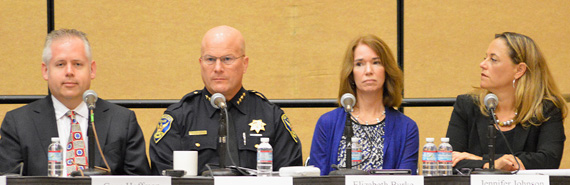
On August 9, Behavioral Health Court team member and Deputy Public Defender Jennifer Johnson participated in a panel discussion entitled “Lawyers, Guns and Money: Prohibitions, Restrictions, Guns in Schools, Civil Liability — Will These Strategies Prevent Gun Violence and Save Lives?”

"Coverage of high-profile shootings often inaccurately connect mental illness and gun violence, says Jennifer Johnson, deputy public defender for [the] Office of the Public Defender 
in San Francisco." (ABANow)
 
Speaking at the "Lawyers, Guns & Money" panel at the 2013 ABA Annual Meeting were (from left) Gene Hoffman of Calguns Foundation, San Francisco Police Chief Greg Suhr, Elizabeth Burke of Lawyers for a Safer America, and San Francisco deputy public defender Jennifer Johnson. (ABANow)


The event was sponsored by the American Bar Association Criminal Justice Section. The following is an excerpt from an article published on ABANow.org:

Ms. Johnson "spoke about the role of mental illness in gun violence. Although she noted that people with mental illness do not have higher rates of gun violence than the general population, she suggested that well-funded mental health systems can help keep people with problems away from guns and other opportunities to do harm."

Click here to read the full article.

Jul 30, 2013

Court-Ordered Mental Health Treatment Shows Positive Results

On July 30, 2013, The New York Times featured an article about legislation enacted in New York State allowing people with mental health disorders to be court-ordered to treatment, even if they are not hospitalized. Kendra's Law, as it is known, also allocates State resources to expand mental health services.

"The program, which costs New York $32 million for the 2,000 to 2,500 people under court order each year, provides intensive monitoring by caseworkers, who are supposed to ensure that patients attend therapy and adhere to medication. Under the law, New York also spends $125 million a year for enhanced outpatient mental health services for others."

The results are promising. 

Researchers from Duke University "examined costs for 634 people who received court orders between January 2004 and December 2005. It compared costs in the year before the court orders, the year after and two years after. Jeffrey Swanson, a psychiatry professor at Duke and lead author of the study, said the results suggested that 'if you pour some money into assisted outpatient treatment, if you target it correctly, there are some significant savings.'

"A co-author, Dr. Marvin Swartz, head of Duke’s social and community psychiatry division, said...  patients 'were less likely to return to the hospital, if they went to the hospital they had shorter lengths of stay, they were more likely to be adherent to medication, and generally they functioned better in the community."

The Duke study was published in The American Journal of Psychiatry.

Click here to read The New York Times article.

Jun 17, 2013

Bay Area Spotlight: Judge Stephen Manley Honored for Mental Health Work

Santa Clara County Judge Stephen Manley Receives National Honor for His Work in Mental Health


NADCP Board Member and Drug Court pioneer Judge Stephen Manley has been awarded the prestigious Jacob K. Javits Award for Public Service by the American Psychiatric Association for his work as a mental health advocate within the justice system. Named for former Senator Jacob K. Javits of New York, the award is given annually to officials that have demonstrated distinguished leadership in supporting psychiatric medicine and mental health advocacy.

Judge Manley founded the Santa Clara County, CA Drug Court in 1994. Under his leadership, Santa Clara’s Drug Court became a national model, and helped spur the implementation of similar programs throughout California. In 1999, Judge Manley launched Santa Clara’s Mental Health Court, which is now the largest in the United States. When he noticed an increase in the number of veterans appearing on his dockets addicted and seriously mentally ill, he once again took action. In late 2008, he launched one of the first Veterans Treatment Courts in the United States. Today, Judge Manley personally presides over a number of Collaborative Justice programs and calendars that include more than 2,300 offenders who participate in treatment and rehabilitation services while on probation or parole.

Judge Manley’s efforts to promote treatment and recovery for the addicted and mentally ill do not end in his courtroom. He has been a tireless advocate for policies that expand these opportunities to every citizen in need. In California, Judge Manley has participated in the drafting of legislation that expanded and funded treatment courts, created and funded pilot reentry courts for parolees, and greater opportunities for veterans to receive treatment as a part of probation. In Washington, DC, he is no stranger to Members of Congress as he is a vigorous and effective advocate for the drug-addicted and mentally-ill in the criminal justice system.

An innovator, visionary, and advocate, Judge Stephen Manley has saved countless lives and impacted criminal justice policy throughout the nation. The National Association of Drug Court Professionals applauds his service to this nation and congratulates him on this much deserved honor.

Source: National Association of Drug Court Professionals


Nov 5, 2012

Veterans Treatment Courts Featured on 60 Minutes

This blog post features an email circulated by Justice for Vets and the National Association of Drug Court Professionals on October 15, 2012.

60 Minutes Hails Veterans Treatment Courts

Last night, 60 Minutes hailed Veterans Treatment Courts for providing ‘Justice for our Veterans’ in a story profiling the Harris County Veterans Treatment Court in Texas. Over thirteen million viewers tuned in for the gripping segment that told the story of several veterans who found redemption in Veterans Treatment Court after coming home and struggling to cope with substance abuse and trauma. “Every two weeks, the vet reports to the judge. Troublemakers are kicked out and sent to the regular probation system. But there haven't been many of those, only nine out of 100 vets so far,” said correspondent Scott Pelley. “Because of that, veterans' courts like this have sprung up in 27 states. There are 100 already with another 100 planned.”

As seen in the story, Arthur Davis was facing twenty years in prison when he became one of the first participants in the Harris County Veterans Treatment Court. The decorated veteran served two decades in the Marine Corps, completing four combat deployments. When he returned home for the final time, he had difficulty engaging with his surroundings, drank to self medicate, and was soon arrested for assault. Thanks to the collaboration in Harris County, he was able to receive treatment for substance abuse and PTSD. Today, Arthur Davis has been sober for two years. “It put me back in a leadership position,” Davis said. “The veterans' court, they prescribed a nice detailed pattern of what you needed to do in order to get on board. And it works.”

In 2011, the Harris County Veterans Treatment Court attended Justice For Vets’ Veterans Treatment Court Planning Initiative (VTCPI), a comprehensive five-day training for new and planned Veterans Treatment Court teams. “Judge Carter and his team are a shining example of how Veterans Treatment Court can transform a community. I congratulate them on this story and thank them for their commitment to ensuring no veteran is left behind,” said Justice For Vets Director Matt Stiner. “Every Veterans Treatment Court should feel proud of last night’s story on 60 Minutes. It is a testament to the unwavering commitment of those who work in these courts, and the incredible capacity for change of the men and women who are served by them. This story sends a strong message that Veterans Treatment Courts will forever change the way the criminal justice system handles veterans.”

To view the entire story, click here.

Nov 2, 2012

Former State Legislator Reflects on Mental Health Policy

As a Connecticut state legislator in the 1980s, Paul Gionnfrido helped pass laws that closed mental health facilities in his state. In this article published in the Washington Post on October 15, 2012, he reflects on his generation's mental health policy decisions and their impact on people like his scizophrenic son 25 years later. In 2010, Mr. Gionfriddo started a blog about health policy issues called Our Health Policy Matters.

My son is schizophrenic. The ‘reforms’ that I worked for have worsened his life.
By Paul Gionfriddo

If you were to encounter my son, Tim, a tall, gaunt man in ragged clothes, on a San Francisco street, you might step away from him. His clothes, his dark unshaven face and his wild curly hair stamp him as the stereotype of the chronically mentally ill street person.

People are afraid of what they see when they glance at Tim. Policymakers pass ordinances to keep people who look like him at arm’s length. But when you look just a little more closely, what you find is a young man with a sly smile, quick wit and an inquisitive mind who — when he’s healthy — bears a striking resemblance to the youthful Muhammad Ali.

Tim is homeless. But when he was a toddler, my colleagues in the Connecticut state legislature couldn’t get enough of cuddling him. Yet it’s the policies of my generation of policymakers that put that formerly adorable toddler — now a troubled 6-foot-5 adult — on the street. And unless something changes, the policies of today’s generation of policymakers will keep him there.

Click here to read the full article.

Oct 23, 2012

"Political System Is Failing Addicted and Mentally Ill Individuals "

With Election Day only two weeks away, this important commentary in The Huffington Post's blog highlights the lack of attention to individuals suffering from drug addition and mental illness during the 2012 presidential election cycle. The author calls for more effective use of federal, state, and local funding to address the addiction and mental health treatment needs of our communities.


"Arresting and incarcerating drug users... without addressing their underlying issues costs... significantly more money than helping those individuals identify and overcome their problems through proper treatment."

"The war on drugs is over, and everybody lost."
By David Sack, M.D. 
October 9, 2012 

The hot-button topic in our current election cycle is the economy. Basically, finances seem to be the sole focus of nearly every campaign. And why not? With unemployment rates hovering in the 8 percent range, our nation's financial situation is a major issue. But almost as many Americans suffer from a serious mental illness as are unemployed, and there are many more people dealing with addiction than are unemployed. Even in an economy-driven election -- perhaps especially in an economy-driven election -- politicians should be paying attention to these facts. After all, whether it is a debilitating mental illness such as bipolar disorder or a mind-addling addiction to prescription medications, these issues cost our nation serious money. And the amount increases when the problems are left untreated or passed off to the criminal justice system.

Sep 9, 2010

New Mental Health Courts Around the Country

The efficacy of Mental Health Courts is evident and it is exciting to see that various counties across the country are joining in this movement. Here are a few related articles.

Sheriff's program to ID mentally ill inmates
By Gary Pinnell
Highlands Today
September 9, 2010

New Alameda County court aims to help mentally ill
By Chris Metinko
Oakland Tribune
September 7, 2010

Shelby County starts mental health court
By Malcomb Daniels
The Birmingham News
September 7, 2010

Mental Health Court keeping people out of jail, saving money
WQOW TV- News Channel 18 (Eau Claire, WI)
August 18, 2010

May 18, 2010

Evaluation on Mental Health Courts in Texas shows promising results

Representing the Mentally Ill Offender
An evaluation of Advocacy Alternatives

By the Texas Task Force on Indigent Defense, Office of Court Administration

In the study researchers hypothesized that mental health courts provide positive outcomes on the following:
Pre‐disposition jail days
Mental health treatment engagement
Case disposition
Recidivism rates

What they found for those participating in mental health courts in Texas was that there were significant increases in long-term treatment engagement for all diagnoses, large statistically significant reductions in the chance of a guilty verdict, and they achieved statistically significant reductions in recidivism up to 18 months after case disposition. There were no statistically significant differences in pre-trial jail days.

**Results are based on all individuals who enrolled in the program including both successful and unsuccessful terminations. This is the most objective measurement approach as it reflects outcomes for everyone intended to benefit from the program – not just those who actually achieved positive results.

If you would like to read the entire report, please see PDF.

Study shows that more mentally ill persons are in jails and prisions

Treatment Advocacy Center* Study reveals that
“More Mentally Ill Persons Are in Jails and Prisons Than Hospitals: A Survey of the States”

Here are a few interesting findings from the report:
-3 times more seriously mentally ill persons are in jails and prisons than in hospitals.
-16% of inmates have a serious mental illness.
-40% of individuals with a mental illness have been in jail or prison at some point in their lives.
-It is becoming even more difficult to find a bed for a seriously mentally ill person who needs to be hospitalized. In 2005 there was one psychiatric bed for every 3,000 Americans.

The study concludes that this problem can be solved with the use of assisted outpatient treatment and mental health courts. San Francisco Collaborative Courts are very proud of our efforts in this area with the application of our awarding winning Behavioral Health Court back in 2002.

*The Treatment Advocacy Center is a national nonprofit organization dedicated to eliminating barriers to the timely and effective treatment of severe mental illnesses. The Treatment Advocacy Center promotes laws, policies, and practices for the delivery of psychiatric care and supports the development of innovative treatments for and research into the causes of severe and persistent psychiatric illnesses, such as schizophrenia and bipolar disorder. For more information visit their website at http://www.treatmentadvocacycenter.org/

Apr 13, 2010

William T. Rossiter Award given to Judge Stephen Manley of Santa Clara

Judge Stephen Manley, Superior Court Judge in Santa Clara County was the recipient of the 2010 William T. Rossiter Award by the Forensic Mental Health Association of California (FMHAC). With over 30 years on the bench he was honored for his exceptional global contribution to the field of Forensic Mental Health.

Congratulations to Jo Robinson!

Jo Robinson, MFT, Director of Jail Psychiatric Services and the Assistant Director of Jail Health Services in San Francisco, was awarded the Christine M. West Award for 2010 by the Forensic Mental Health Association of California (FMHAC) at this year’s annual conference. The West Award recognized Jo for her valuable contributions and dedication in the field of Forensic Mental Health.

Dec 7, 2009

Upcoming Webinar on Behavioral Health Services & the Criminal Justice System

Tune in Tomorrow, December 8th at 11am (Pacific standard time)

Ending an American Tragedy: A National Leadership Forum Webinar

The National Council for Community Behavioral Healthcare has organized a webinar to review recommendations for effective collaboration outlined in a recent Report from the National Leadership Forum on Behavioral Health/Criminal Justice Services. Forum leaders highlight current innovative and successful programs across the country. The presenters will discuss the Essential System of Care and how it can be used in planning community responses to justice involved persons. The National Leadership Forum is co-chaired by the National Council and the CMHS National GAINS Center.

Register for the webinar NOW!

Sep 28, 2009

FRONTLINE Broadcast on Mentally Ill Offenders

Back in April 2009, the PBS series FRONTLINE broadcast a film called "The Released," which explores what happens to mentally ill offenders once they are released from prison.
A video clip is available at: www.pbs.org/wgbh/pages/frontline/released/.

Sep 18, 2009

A Call to Action

The National Leadership Forum on Behavioral Health/Criminal Justice Services (NLF),established in 2008 to address common barriers to successful diversion and reentry, has recently published a report on the issue of addressing the needs of people with mental illness in the criminal justice system.

“Now, more than ever, as we strive to provide health care to our most vulnerable citizens, we must address this serious public health and public safety crisis.”

The report recommends eight essential evidence-based services for justice-involved people with mental illness: 1) Forensic Intensive Case Management; 2) Supportive Housing; 3) Peer Support; 4) Accessible and Appropriate Medication; 5) Integrated Dual Diagnosis Treatment; 6) Supported Employment; 7) Assertive Community Treatment; and, 8) Cognitive Behavioral Interventions Targeted to Risk Factors.


Read the full report-

Ending an American Tragedy: Addressing the Needs of Justice Involved People with Mental Illnesses and Co-Occurring Disorders

Sep 17, 2009

Human Rights at Home: Mental Illness in U.S. Prisons and Jails

On September 15, the Senate Committee on the Judiciary, Subcommittee on Human Rights and the Law, discussed the prevalence of mental illness among those incarcerated in the United States, and what we can do to address this significant problem.

Watch the webcast, featuring Senators Richard Durbin and Al Franken.

San Francisco Behavioral Health Court was created in 2002 in response to the increasing number of mentally ill defendants cycling through San Francisco's jails and courts. Through a combination of judicial supervision, collaborative decisionmaking among partner agencies, and intensive case management, BHC seeks to reduce recidivism by helping defendants with serious mental illness access community treatment.