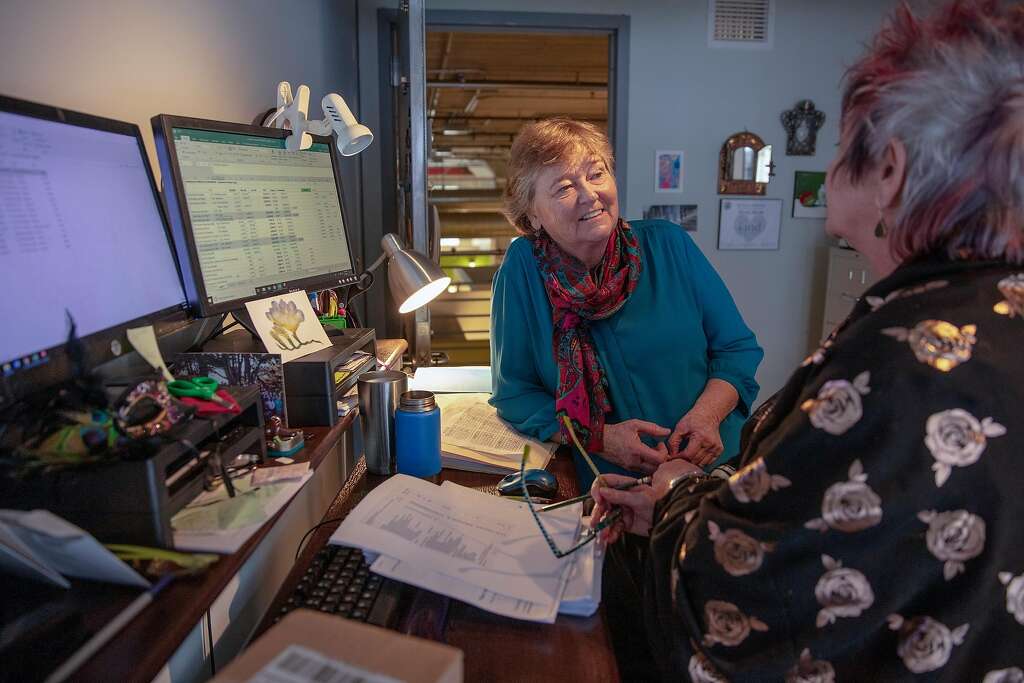
Martha Ryan, founder and executive director of the Homeless Prenatal Program, "is one of six finalists for Visionary of the Year, an annual recognition by The Chronicle of Bay Area leaders whose work improves the world." Her story is highlighted in an article published on SFGATE today.
Photo: Photos By Peter DaSilva / Special To The Chronicle
The San Francisco Family Treatment Court (FTC) has the great fortune to partner with Martha Ryan and the Homeless Prenatal Program to support families impacted by parental substance use disorders navigating the juvenile dependency system. FTC was implemented in 2007, and the Homeless Prenatal Program has been one of its primary partner agencies from the beginning.
We look forward to the next 12 years of strengthening families together!
This Strategic Plan provides a framework for a coordinated national strategy to enhance and expand the use of family drug courts to improve the outcomes for children and families affected by parental substance use disorders. The primary goals of the plan are to:
1) Improve the effectiveness of the existing family drug court network by assuring it operates with fidelity to the model;
2) Expand the reach of family drug courts to keep families together and reduce child maltreatment; and
3) Continue to build the evidence base about what works for family drug courts to improve outcomes for children and parents.
Developed with a diverse group of stakeholders, the Strategic Plan is pertinent to all policymakers, practitioners, researchers, foundations, and advocates committed to improving child welfare and substance use disorder treatment outcomes for children and parents.
NADCP CEO Carson Fox notes, 'Of the more than 400,000 children in foster care, the majority are there because of a parent or caregiver who is in need of treatment for alcohol or drugs. This plan lays out a pathway to ensure all children and families have access to effective, evidenced-based services that are proven to improve child welfare outcomes. It advances justice for children and families affected by substance use disorders in a way that the field has never done before.'" Download the Strategic Plan here.
City Youth Now made the holidays extra special this year for families participating in the San Francisco Dependency Drug Court by providing toys, games, and gift cards for 75 children served by the collaborative court.
"This time of year is especially stressful for families in the juvenile court system," says Judge Kathleen Kelly. "The overwhelming generosity of City Youth Now will bring joy to the children who need it most, and relief and comfort to the parents who so very much want their children to have a special gift for the holidays."
Superior Court Judge Kathleen Kelly organizes helps organize gifts to distribute to DDC families.
Nick from City Youth Now delivers bagfuls of toys and games to the San Francisco Superior Court.
City Youth Now works to ensure that youth in the juvenile court system have the same positive youth development opportunities as other children to grow into mature and successful adults. They have provided thousands of holiday gifts to abused, neglected, and troubled children in the San Francisco juvenile court system for 60 years. Click here to learn more.
PBS recently aired Tough Love, a documentary that follows two families navigating the child welfare system, one in New York and the other in Seattle. The film provides a behind-the-scenes view of the King County Family Treatment Court in Seattle, which helps parents with substance use disorders reunify with their children and resolve the issues that brought them into the child welfare system.
Film Description
Tough Love chronicles the separate journeys of Patrick Brown, a single, white father in Seattle, and Hasna "Hannah" Siddique, a newly married Bangladeshi-born mother of two in New York City, as they fight to make their families whole again after their children were taken from them due to neglect. Through intimate, vérité footage, we witness firsthand the complex bureaucracy of America's child welfare system and the powerful role that poverty and other challenges play in keeping parents and children apart.
It is conservatively estimated that more than 2 million children are in state-sponsored care worldwide. In the United States, more than 400,000 children were living without permanent families in 2013. In 2012, 78 percent of cases reported to child protective services agencies involved findings of neglect, not abuse. Although each state defines neglect differently, allegations often involve poverty, mental illness, addiction, domestic violence and/or children with significant developmental challenges. Among the thought-provoking questions Tough Love raises are these: Do parents charged with neglect deserve a second chance? Who decides? Is there more that can be done to address the factors that contribute to cases of neglect?
Tough Love does not attempt to answer these
questions, take sides or set out to show failings in the child welfare
system. It simply trains an unflinching eye on the ghosts of the foster
care system--the individuals rarely, if ever, depicted in mainstream
media--parents who love their children and are struggling to reclaim
them. Tough Love is the first documentary to be granted
yearlong access to film inside Seattle's Family Treatment Court (FTC).
Never before has the public been privy to the roundtable discussions
between social workers and lawyers in the court, and few are aware of
the multiple bureaucracies parents must manage and the services that
they and their children desperately need to improve their chances of
reunification.
We first meet 40-something single dad Patrick Brown in Seattle's FTC,
a court with innovative programs that help parents with histories of
substance abuse reunite with their children. Patrick's 4-year-old
daughter, Natalya, has been living with a loving Italian foster family
since Patrick, fearing for her life, called Child Protective Services
about the child's meth-addicted mother. After 15 months in the court
program, Patrick, a journeyman landscaper, handyman and recovering meth
addict himself, is now sober, holding down a steady job and inching
closer to being reunited with Natalya. But he slips--gambling away his
rent money and drinking a glass of wine after an emotional Fourth of
July holiday without his daughter.
Patrick's team of social workers and advocates, along with Judge
Julia Garratt, begin to question his recovery and ability to parent his
child safely. As attendance at Alcoholics Anonymous and Gamblers
Anonymous meetings is added to his list of responsibilities, the judge
considers terminating his parental rights. Patrick begins to wonder
whether he "has what it takes to be a father," or whether Natalya would
be better off being adopted by her foster family.
Meanwhile, across the country in New York City, seven-months pregnant
Hannah Siddique and her husband, Philly, are preparing for the birth of
their first child. Like any young couple, they seem happy and very much
in love. But two years earlier, Hannah's two children from a
relationship with an abusive ex-boyfriend were taken from her after the
New York City Administration for Children's Services (ACS) learned that
she had left her son and daughter with her mother for nights at a time.
Was it poor judgment or neglect? Today, Hannah says that she's trying to
move forward, but "my past is just haunting us."
Hannah admits that at the time her children were removed from her
care, "I was clueless as to what it was to be a mother." But now she is
determined to prove that she can be a responsible parent and that with
Philly, she can create a safe and loving home for her children. Philly, a
Dominican New Yorker with a sweet, upbeat nature, is with Hannah every
step of the way. He works seven days a week in a food truck and at a
tile factory, earning barely enough to make ends meet, and all he wants
is to be a good husband, father and provider.
Hannah starts to attend weekly parent support group meetings at the
Child Welfare Organizing Project (CWOP) in East Harlem. Despite her
excitement about having a baby, she is frustrated by the lack of
movement on her two-year case with ACS, through which she is seeking to
be reunited with her older children. Then, at a CWOP meeting, Hannah and
Philly learn a devastating fact: the safety of their newborn child will
also be under investigation because of the still-open case.
To make matters worse, the two also discover that living with
Philly's mother, as they do now, is a liability that increases the
chances that ACS will take their new baby. With no other options, they
apply for a spot in a family homeless shelter. In the midst of all this,
healthy baby Mia is born. After failing to qualify for the shelter,
Hannah and Philly return to his mother's house with Mia and hope for the
best.
In Seattle, we last left Patrick questioning whether he has what it
takes to be a father. But on the heels of the judge's "tough love"
approach, Patrick's FTC team jumps into action. It's clear they're
rooting for him and have come to the conclusion that his self-sabotage
is grounded in fear and anxiety. Together, with markers and whiteboards
and just the right amount of levity, they map out a plan. This time, the
scales just might tip in Patrick's favor.
Tough Love, a compassionate inside look at the child
welfare system, shows the remarkable discretion and power that judges
have in defining what makes a parent a parent--and a family a family.
Put under the microscope of child protective services, which parents
would pass the test? The film illustrates the disparity between various
state systems and bears witness to the often-overlooked and
unappreciated role that social workers, lawyers and parent advocates
play as cases drag on for years.
"I hope Tough Love gives audiences a glimpse of the
lives inside the child-welfare system, the lives of the families and
workers who spend countless hours navigating this complex bureaucracy,"
says filmmaker Stephanie Wang-Breal. "At the end of the day, it is a
system made of people. People who are faced with complex issues like
housing, welfare, domestic violence and substance abuse. People who have
to overcome unimaginable obstacles to have a family again.
"Too often, adoption is seen as the only option for children in
foster care. Through Hannah, Philly and Patrick's stories, I hope to
show audiences that these children have parents who love them and are
willing to do whatever it takes to get them home."
According to SAMHSA, research shows a strong graded (i.e., dose-response)
relationship between ACEs and a variety of substance use-related
behaviors, including:
Early initiation of alcohol use (Dube et al, 2006)
Problem drinking behavior into adulthood (Dube et al, 2002)
Prescription drug use (Anda et al, 2008)
Lifetime illicit drug use, ever having a drug problem, and self-reported addiction (Dube et al, 2003)
The Substance Abuse and Mental Health Services Administration (SAMHSA) released its Children Affected By Methamphetamine (CAM) Brief. CAM is a SAMHSA-funded grant program focused on expanding and/or enhancing services to
children and their families who are affected by parental methamphetamine use and
abuse. Four-year CAM grants were awarded to 12 Family Treatment Drug Courts (FTDCs) nationwide, six in California.
The following are highlights from the CAM program (p. 6 of the brief): The CAM grantees’ preliminary outcomes make clear that a comprehensive family-centered FTDC approach that addresses the specific needs of children and families, in addition to a parent’s recovery, contributes to improved child, parent, and family well-being.
The majority of children at risk of removal remained in the custody of their parent(s) and did not experience maltreatment after entering the CAM program.
The majority of children in out-of-home placement achieved timely reunification with their parent(s). After returning home, very few children re-entered foster care.
Adults stayed in substance abuse treatment (on average, about 6 months) and nearly half successfully completed treatment.
The majority of adults also reduced their use of alcohol, marijuana and methamphetamine.
Families showed statistically significant improvements in their overall child well-being and family functioning, with the greatest gains made in family safety, readiness for reunification, and parental capabilities.
“The Court understands the impact of intergenerational poverty and drug addiction on the children served by Dependency Drug Court. This initiative will help the Court strengthen its partnerships and provide targeted services to nurture parent-child relationships and family stability.”
– Presiding JudgeCynthia Ming-mei Lee
San Francisco was selected as one of four sites to receive a Doris Duke Foundation Prevention and Family Recovery (PFR) grant to enhance services for families participating in Dependency Drug Court (DDC). Representatives from San Francisco's multidisciplinary team attended the PFR Leadership Development kick-off meeting this month in Newport Beach, CA.
L-R: Eden Woldemariam (Homeless Prenatal Program), Katie Best (HealthRIGHT 360), Sylvia Deporto (Human Services Agency), Lynn Dolce (Department of Public Health), Jennifer Pasinosky (Superior Court), Dora Miranda (Superior Court), Miriam Silverman (Infant Parent Program), Jill Gresham (Children & Family Futures), Hon. Linda Colfax (Superior Court), Theresa Lemus (Children and Family Futures) Not pictured: Kimberlee Pitters (Department of Public Health)
The PFR initiative is overseen by Children and Family Futures, a nonprofit leader in the field of Family Drug Courts. Through this grant, DDC will provide evidence-based in-home parenting education to all participating families with children 0-5 years old and implement a “One Family, One Plan” strategy to ensure parent, child, and family services are integrated and highly coordinated across systems.
DDC's efforts will build upon the Interagency Service Collaborative (iASC), San Francisco's response to the Katie A. settlement agreement in California, requiring county governments to "improve the provision of mental health and supportive services for children and youth in, or at imminent risk of placement in, foster care in California."
The PFR grant also includes intensive technical assistance and program evaluation to support systemic change, identify best practices, and disseminate findings to other Family Drug Courts across the country. The other three sites were Robeson County, NC, Tompkins County, NY, and Pima County, AZ.
DDC's partners are excited for the opportunity to provide enhanced parenting services and implement systemic changes that help strengthen families and support long-term success. The project implementation date is July 1, 2014.
Description
The judge serves as a central figure of leadership in the FDC by serving
as a team leader in bringing various systems together and overseeing
the progress in treatment and recovery of participants in the FDC. The
judge is also in a position to influence related reform efforts and
keeping colleagues and the community informed about the FDC. So what
happens when such leaders either transition or rotate out of this
position? This webinar presentation will explore key considerations to
effectively plan for judicial succession in the FDC. The presentation
will include perspectives of two judicial officers who will share their
reflections on judicial leadership and strategies on how to ensure a
smooth transition to the next leader on the bench.
Learning Objectives
The importance of succession planning, why it is an overlooked key process, and the cost of ineffectual planning
Key
strategies and considerations in terms of selection, orientation,
training, and development of new judicial bench officers
The
technical skills and intangibles of being an effective FDC judge, team
leader, and champion within the community program
Presenters
Honorable Erica Yew, Santa Clara Superior Court, California
Honorable Kyle B. Haskins, 14th Judicial District, Tulsa, Oklahoma
Presenters: Nancy K. Young, PhD, Executive Director, Children and Family Futures Jane Pfeifer, MPA, Senior Program Associate, Children and Family Futures Honorable Barbara Salinitro, Queens County Family Court, New York Connie Almeida, PhD, LSSP, Infant Toddler Court Initiative Director, Harris and Fort Bend Counties, Texas
Webinar Description: One of the most important decisions faced by each FDC is determining its target population and what resources are needed to serve them. This webinar presentation will provide an overview of key considerations when selecting and modifying your target population and why a collaborative approach is critical when making such decisions. Whether you are planning a new FDC or an established program, these decisions are critical to the mission, practice and policies, outcomes, and sustainability of your FDC. This webinar will highlight two FDC programs and the collaborative process they underwent in determining and serving the needs of special populations in their FDC. Special focus will be on serving co-occurring clients and children ages 0-3.
Congratulations to the Homeless Prenatal Program (HPP) for winning Best Local Nonprofit in the SF Bay Guardian's Best of the Bay! http://www.sfbg.com/bob/2008/city.php
A partner agency in the San Francisco Superior Court's Dependency Drug Court, HPP provides intensive case management for parents with substance abuse issues involved in the dependency court/child welfare system.